8 Oz to Cups: Exact US Fluid Ounces to Cups Conversion
8 US fluid ounces equals exactly 1 US cup. Under the US Customary system, one standard liquid measuring cup holds exactly 8 fluid ounces (fl oz), 16 tablespoons, or approximately 236.59 milliliters. This conversion applies to liquid volume; dry ingredients measured in weight ounces depend on density and do not equal 1 cup.
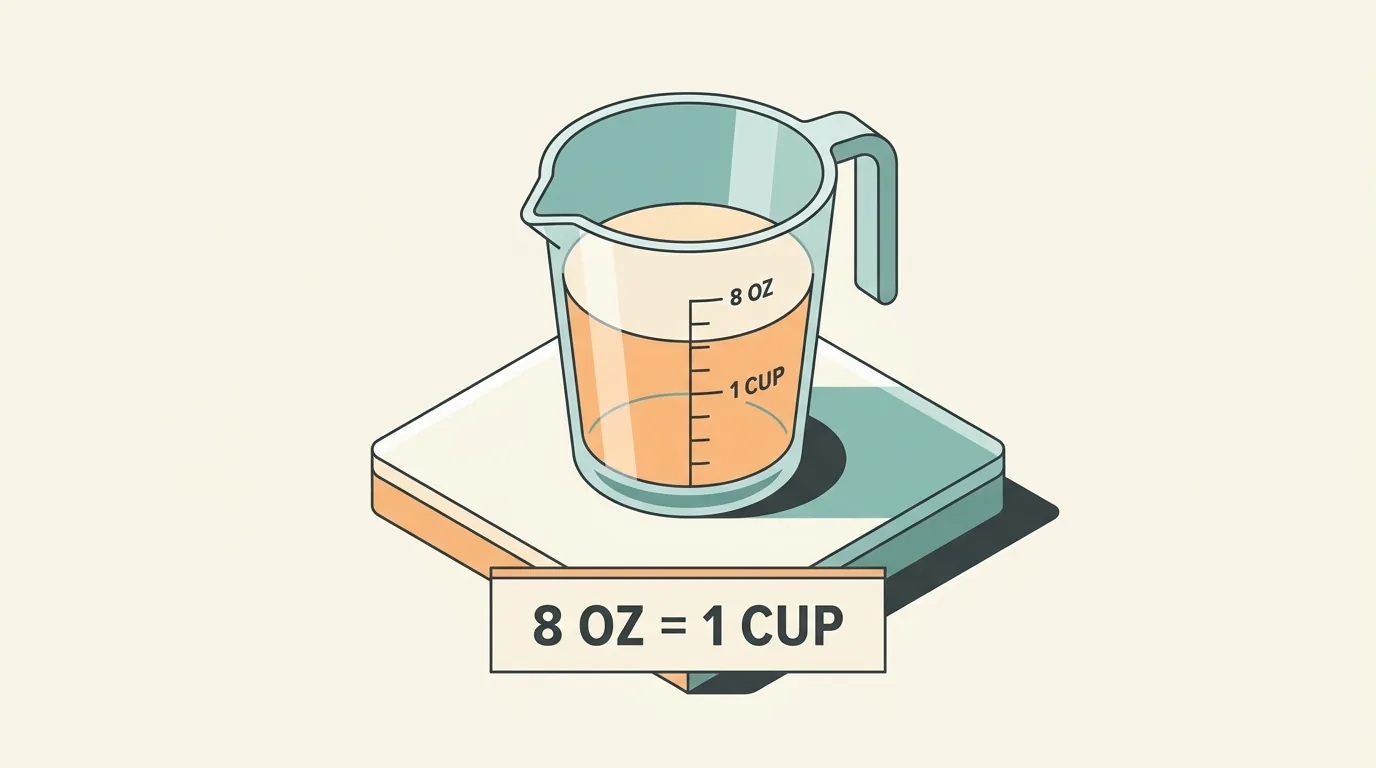
8 US fluid ounces equals exactly 1 US cup. Under the US Customary system, one standard liquid measuring cup holds exactly 8 fluid ounces (fl oz), 16 tablespoons, or approximately 236.59 milliliters. This conversion applies to liquid volume; dry ingredients measured in weight ounces depend on density and do not equal 1 cup.
Convert fluid ounces to cups, tablespoons and milliliters with exact US Customary math.
Best solution
8 US fluid ounces equals exactly 1 US cup.
Convert fluid ounces to cups, tablespoons and milliliters with exact US Customary math.

Keep fast calculators and daily tools pinned right to your desktop.
Key solutions at a glance The main decisions from this guide, condensed into one table.
Use the Conversion Calculator
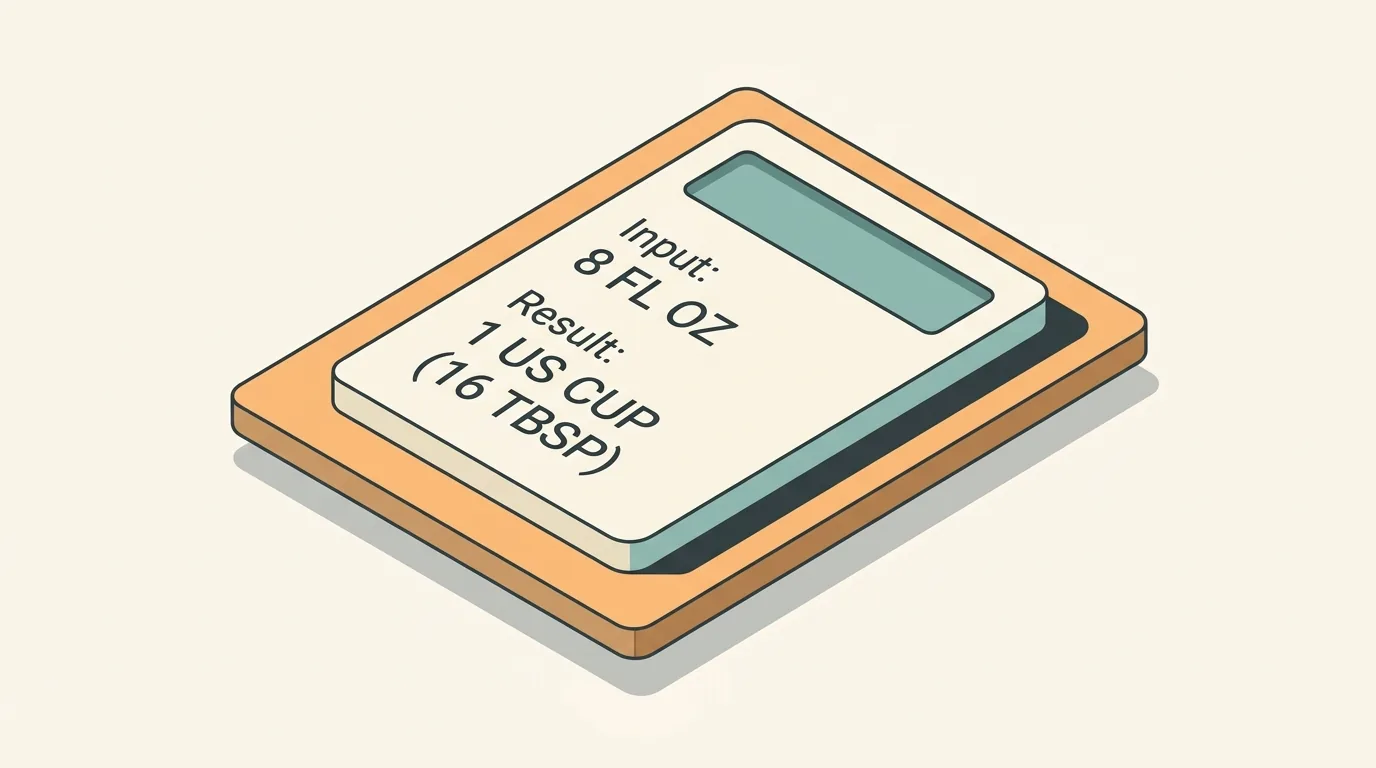
Enter the fluid ounce volume you wish to convert. The default is 8 fl oz, which instantly calculates 1 US cup.
Select between US fluid ounces and US customary cups. Use the Swap button to reverse the calculation (e.g. 1 cup to 8 fl oz).
Check secondary volume equivalents: 8 fl oz equals 16 tablespoons or approximately 236.6 milliliters.
Copy the verified conversion with formula context to paste directly into your recipe notes or kitchen timers.
How the Exact Calculation Works
The US Customary system defines 1 cup as exactly 8 fluid ounces. Mathematically: cups = fluid ounces ÷ 8. Therefore, 8 fl oz ÷ 8 = 1.0 cup. Keep in mind that a fluid ounce is a unit of volume, whereas an ounce on a kitchen scale measures mass. For water, 8 fluid ounces weighs approximately 8.34 ounces, but for flour, 1 cup weighs only about 4.25 ounces.
A Practical Kitchen Walkthrough: Measuring Accurately in Recipes
Consider a real-world kitchen scenario: preparing an artisan brioche or a savory reduction that specifies 8 fluid ounces of warm whole milk or clarified broth. In culinary measurement, 8 US fluid ounces corresponds directly to 1 level standard US cup. When pouring into a liquid measuring cup placed on a flat countertop, align your eye at eye level with the graduated meniscus line: the curved lowest boundary of the liquid surface must rest precisely at the 8 fl oz (1 cup) mark. If you attempt to measure this using a standard dry scoop rather than a spouted liquid vessel, surface tension and vessel brim curvature routinely introduce an inadvertent 5% to 10% discrepancy. Furthermore, if your kitchen scales are active and you weigh the liquid, 8 fluid ounces of whole milk will register approximately 8.6 ounces (244 grams) due to milk's specific gravity of 1.03, whereas pure water registers approximately 8.34 ounces (236.6 grams). Understanding that 8 fluid ounces is an invariant volumetric definition (1/16th of a US gallon or 16 level tablespoons) guarantees that your dough hydration, emulsion ratios, and baking chemistry remain perfectly consistent across consecutive culinary batches.
Ingredient Weight & Volume Reference Table
| Ingredient Staple | Volume Measurement | Net Weight (Avoirdupois) | Metric Equivalent |
|---|---|---|---|
| Water & Clarified Broth | 1 US Cup (8 fl oz) | 8.34 oz | 236.6 g |
| Whole Milk & Buttermilk | 1 US Cup (8 fl oz) | 8.60 oz | 243.8 g |
| Vegetable & Olive Oil | 1 US Cup (8 fl oz) | 7.68 oz | 217.7 g |
| All-Purpose Flour (Dip & Sweep) | 1 US Cup (8 fl oz equiv) | 4.25 to 4.50 oz | 120 to 128 g |
| Granulated White Sugar | 1 US Cup (8 fl oz equiv) | 7.10 oz | 201.3 g |
| Packed Brown Sugar | 1 US Cup (8 fl oz equiv) | 7.75 oz | 219.7 g |
| Pure Clover Honey / Molasses | 1 US Cup (8 fl oz) | 11.90 oz | 337.4 g |
| Unsalted Butter (2 standard sticks) | 1 US Cup (8 fl oz equiv) | 8.00 oz (1/2 lb) | 226.8 g |
Notice that dry ingredients deviate significantly from liquid measures when measured by weight. Flour and cocoa are aerated and significantly lighter than water, while honey and syrups are much denser.
Fluid Ounces vs. Dry Weight Ounces: Critical Measurement Mechanics
The word "ounce" represents two fundamentally distinct physical dimensions: fluid ounces (fl oz) quantify volumetric capacity, whereas avoirdupois ounces (oz) quantify gravitational mass. A fluid ounce occupies precisely 1.80469 cubic inches (29.5735 milliliters) regardless of whether it is filled with featherlight foam or dense liquid gold.
When working with dry baking pantry staples such as all-purpose flour, aerated sifted flour occupies approximately 4.25 ounces per cup, whereas compacted flour settled during transport can exceed 5.0 ounces per cup. Never equate an 8 oz weight reading on a digital kitchen scale with 8 fluid ounces unless the substance has a specific gravity of 1.00 at room temperature.
For viscous liquids such as molasses, corn syrup, or cold honey, residual adherence to measuring cup walls causes under-delivery into mixing bowls. Lightly misting the measuring vessel with neutral oil spray before pouring 8 fluid ounces ensures complete volumetric transfer.
International Cup Standards (US vs. UK vs. Metric)
The United States Customary Cup holds exactly 8 US fluid ounces, translating to 236.588 milliliters (16 US tablespoons). This is the baseline standard for historic American cookbooks and domestic kitchenware.
The United States Legal Nutrition Cup, mandated by the FDA for packaged food nutrition fact panels, is rounded to exactly 240.0 milliliters (8.115 US fluid ounces). Serving sizes on cereal cartons or milk jugs rely on this legal metric.
The British Imperial Cup historically represents half of an Imperial pint (10 Imperial fluid ounces), holding 284.13 milliliters. An Imperial cup is roughly 20% larger than a standard US customary cup.
The Metric Cup, universally adopted across Australia, New Zealand, Canada, and South Africa, is defined cleanly as 250.0 milliliters (approximately 8.45 US fluid ounces). When preparing international recipes, verify which cup standard the author assumes before measuring.
Quick Reference Table and Nearby Benchmarks
| Input Value | Conversion Formula | Resulting Measurement |
|---|---|---|
| 8 fl oz | fl oz ÷ 8 | 1 US cup (16 tbsp) |
| 4 fl oz | fl oz ÷ 8 | 0.5 US cup (1/2 cup) |
| 12 fl oz | fl oz ÷ 8 | 1.5 US cups (1 1/2 cups) |
| 16 fl oz | fl oz ÷ 8 | 2 US cups (1 pint) |
Use these reference benchmarks to verify your recipe, dimensions, or temperature settings before committing changes to your notes or project files.
Important Measurement Boundaries & Traps
Fluid ounces measure volume, while avoirdupois ounces measure weight. Never use 8 oz on a scale to measure 1 cup of dry flour or sugar.
Different regional cup standards exist: a US Customary cup is 236.59 ml, a US Legal Nutrition cup is 240 ml, and an Imperial (UK) cup is 284.13 ml.
Liquid measuring cups with spouts provide accurate meniscus reading, whereas dry measuring cups should be leveled flat.
Save Converted Values to Your Workflow
Always preserve the original units and calculation formula beside your final answer. An isolated number without its unit context can lead to costly errors in baking, manufacturing, or travel planning.
All calculations run 100% client-side in your browser with zero latency and zero data transfer. Your inputs remain private on your local device.
Kepo provides customizable desktop widgets for quick reference, unit monitoring, and everyday productivity. Keep fast calculators and daily tools pinned right to your desktop for easy, glanceable access.
Explore more unit conversion guides and desktop utilities:
Frequently Asked Questions
Is 8 oz always 1 cup?
Yes, for liquid volume measured in US fluid ounces (8 fl oz = 1 cup). It is not true for dry ingredients measured by weight.
How many tablespoons are in 8 oz?
There are 16 tablespoons in 8 fluid ounces (2 tablespoons per fluid ounce).
How many milliliters are in 8 fluid ounces?
8 US fluid ounces is approximately 236.59 milliliters (often rounded to 240 ml on nutrition labels).
Accurate measurements require keeping the input, conversion factor and final unit together. Save all three for reproducible results.
Stay informed with Kepo on your desktop
Embed interactive widgets, monitor dynamic sites, track APIs, and run ambient AI agents right on your macOS desktop.
Related Articles
View all posts →16 Oz to Cups: Exact US Fluid Ounces to Cups Conversion
16 US fluid ounces equals exactly 2 US cups (or 1 US liquid pint). In culinary recipes, beverage containers and liquid measurement, 16 fl oz provides 2 full standard 8-ounce measuring cups, 32 tablespoons, or approximately 473.18 milliliters. If measuring dry goods, 16 weight ounces equals 1 pound.
32 Oz to Cups: Exact US Fluid Ounces to Cups Conversion
32 US fluid ounces equals exactly 4 US cups, which also equals 2 liquid pints or 1 US liquid quart. This equals approximately 946.35 milliliters (just under 1 liter). It is the exact capacity of standard 32-ounce water bottles and store-bought quart cartons of chicken broth or milk.
4 Oz to Cups: Exact Half Cup Measurement Conversion
4 US fluid ounces equals exactly 0.5 US cup (1/2 cup), which also equals 8 tablespoons, 24 teaspoons, or approximately 118.29 milliliters. In baking, 4 ounces of butter is equivalent to 1 standard stick (1/2 cup).
12 Oz to Cups: Exact Fluid Ounces to Cups Conversion
12 US fluid ounces equals exactly 1.5 US cups (1 1/2 cups), which equals 24 tablespoons or approximately 354.88 milliliters. A standard North American soda, seltzer, or beer can holds 12 fluid ounces, providing one and a half standard measuring cups of liquid.