90 days from today: exact date, business days, and planning
Find the exact calendar date 90 days from today, calculate remaining business days, explore a 30/60/90-day reference table, and pin live countdown widgets to your Mac desktop.


Calculating what date falls exactly 90 days from today is one of the most frequent scheduling tasks in corporate operations, legal contracts, and software engineering sprints. Whether you are setting quarterly company objectives, managing an employee probation timeline, drafting vendor contracts, or mapping agile product releases, a 90-day horizon represents the definitive milestone boundary.
However, simply adding three calendar months to your current date creates a dangerous illusion for realistic project delivery. While a 90-day period looks like ample time on a wall calendar, it delivers only 64 to 66 actual working days once normal weekends and statutory public holidays are removed. Knowing how to translate this timeframe into real operational runway is crucial for avoiding eleventh-hour project crunches.
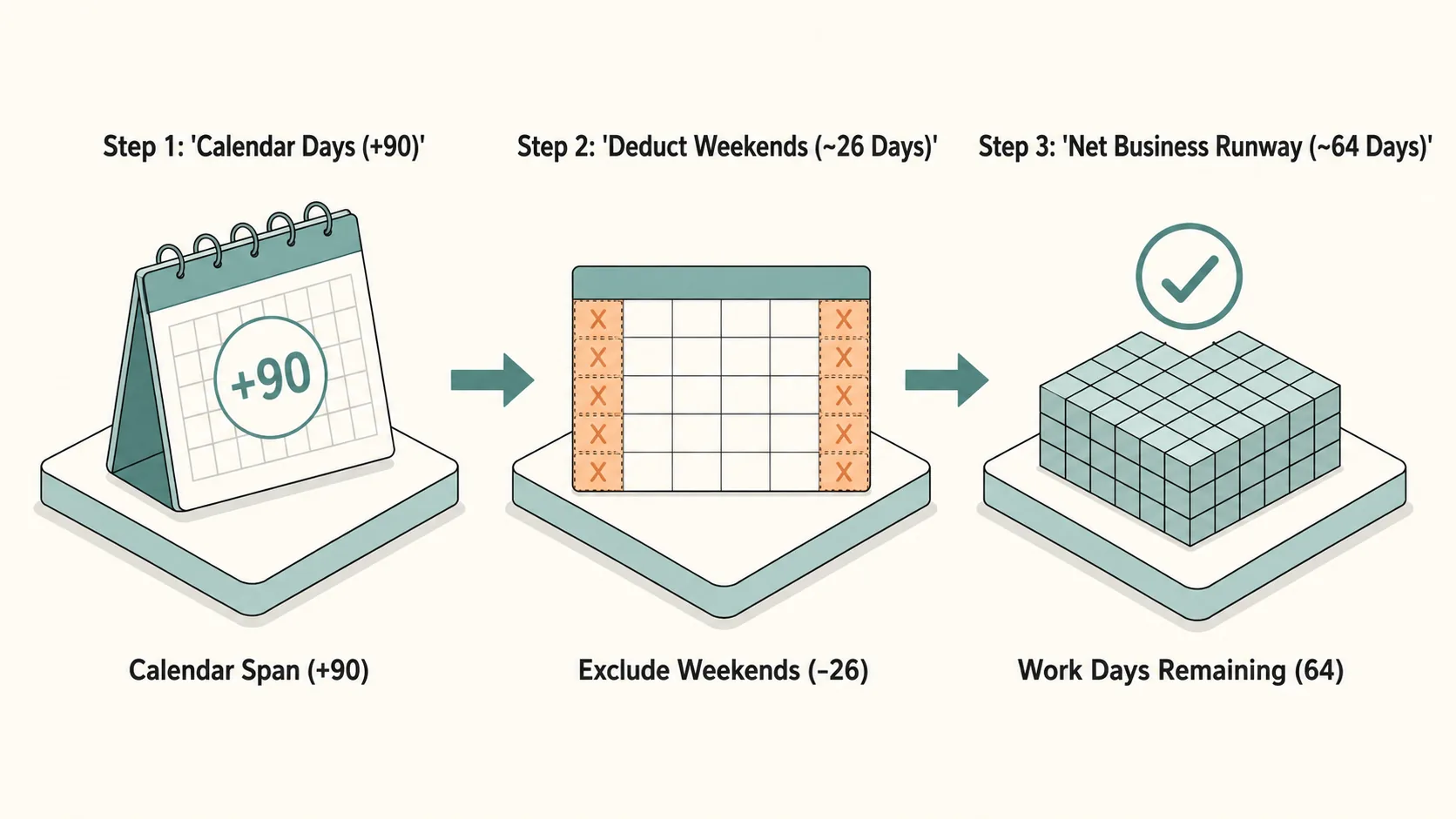
The core operational rule: 90 calendar days translates into exactly 12 full weeks plus 6 additional days. That means every single 90-day window automatically burns 24 to 26 weekend days, leaving roughly 64 net business days before factoring in federal or regional statutory holidays.
Dec 4, 2026
64 days
26 days

Keep this tool always pinned to your desktop wallpaper
Key solutions at a glance The main decisions from this guide, condensed into one table.
Quick Answer: How to Calculate 90 Days From Today
To calculate the exact date 90 days from today, determine whether your timeline operates on calendar days or business days. In standard calendar counting, you advance your calendar across the upcoming three calendar months by exactly 90 days, taking into account varying monthly lengths (30, 31, or 28/29 days in February).
For instance, if today is September 5, 2026, adding 90 calendar days lands exactly on Friday, December 4, 2026. This span accounts for 25 remaining days in September, 31 days in October, 30 days in November, and the first 4 days of December (25 + 31 + 30 + 4 = 90 days).
If your agreement specifies business days rather than calendar days, the target completion date shifts substantially further into the future. A project requiring 90 net business days spans approximately 18 calendar weeks—pushing delivery out by more than four full calendar months.
Step-by-Step Breakdown: The 90-Day Math Explained
When estimating a 90-day milestone, many project leads mistakenly multiply three months by 30 days. Because the Gregorian calendar alternates between 30 and 31 days, and February has 28 or 29 days, rough multiplication introduces cumulative errors of up to two days. Here is the verified step-by-step arithmetic for precision planning:
Step 1: Account for Exact Month Lengths. Always tally days based on the exact calendar months ahead. For a 90-day window launched in September, the months involved have 30, 31, and 30 days respectively. For a 90-day project initiated on January 1, the window includes February (28 or 29 days) and March (31 days), pushing the target completion date further into April.
Step 2: Isolate Weekend Days. 90 days divided by 7 equals 12 full weeks with 6 remainder days. Since every complete week contains a Saturday and Sunday, 12 weeks contribute 24 weekend days. Depending on which day of the week the window starts, the 6 remainder days will capture either one or two additional weekend days. Thus, any 90-day window always contains either 24, 25, or 26 weekend days.
Step 3: Deduct Recognized Holidays. Subtracting 26 weekend days leaves a maximum of 64 business days. In most jurisdictions, a 90-day period intersects at least one to three federal or bank holidays (such as Labor Day, Thanksgiving, Memorial Day, or Christmas), reducing practical engineering and delivery capacity to approximately 61 to 63 working days.
Step 4: Inclusive vs. Exclusive Boundary Alignment. Verify whether day one is billable or active. If both the kickoff day and final delivery day are included, your active window contains 91 calendar days, which may alter your final weekend tally.
30, 60, 90, and 180 Days Reference Table
To assist with roadmap planning, hiring probation reviews, and procurement contracts, use this quick reference cheat sheet comparing common operational intervals. All figures assume a standard Monday-through-Friday 5-day work week without intermediate statutory holidays:
| Interval From Today | Calendar Duration | Equivalent Weeks | Net Business Runway | Primary Business Use Case |
|---|---|---|---|---|
| 14 Days From Today | 14 calendar days | 2.0 weeks | 10 working days | Agile sprint iteration & customer trial notice |
| 30 Days From Today | 30 calendar days | ~4.3 weeks | 21–22 working days | Monthly billing cycle & invoice Net-30 payment |
| 45 Days From Today | 45 calendar days | ~6.4 weeks | 31–33 working days | Enterprise procurement review & vendor RFP tender |
| 60 Days From Today | 60 calendar days | ~8.6 weeks | 42–44 working days | Mid-quarter progress review & hiring probation |
| 90 Days From Today | 90 calendar days | ~12.9 weeks | 64–66 working days | Quarterly OKRs, fiscal roadmap & major product launch |
| 180 Days From Today | 180 calendar days | ~25.7 weeks | 128–132 working days | Semi-annual strategy review & commercial lease review |
This reference matrix clearly demonstrates why a quarterly deadline requires disciplined tracking: when evaluating 90 days from today, team capacity is 28% lower than calendar duration suggests. For high-stakes delivery, budgeting by working days prevents unexpected project overruns.
Operational Pitfalls: Why Month Lengths and Timezones Matter
Even experienced managers encounter unexpected variances when tracking quarterly deadlines. Three common variables frequently disrupt relative date calculations:
1. Leap Year Discrepancies: A leap year inserts an extra 29th day into February. A 90-day contract starting in mid-December or January of a leap year will conclude 24 hours earlier in calendar date than in a standard non-leap year.
2. Cross-Border Timezone Boundaries: In global software teams spanning North America, Europe, and Asia-Pacific, setting a quarterly deadline without an explicit UTC timestamp creates conflicting milestone dates. While it may still be Thursday in California, Tokyo has already crossed midnight into Friday.
3. In-Lieu Holiday Observation: When a statutory holiday falls on a weekend, corporate payroll and commercial banks observe the holiday on the preceding Friday or succeeding Monday. Automated tools and spreadsheets must incorporate company-specific holiday schedules to maintain accurate working day metrics.
Why Static Documentation Fails for 90-Day Goals
Teams frequently determine target completion dates during kickoff meetings and record the deadline in a spreadsheet, presentation deck, or issue tracker. Within two weeks, team members lose visibility over how much active runway actually remains.
Static documentation requires active, intentional effort to consult. Team members must open the spreadsheet, check today’s date, subtract the elapsed days, and recalculate remaining work weeks. In fast-paced engineering or sales environments, deadlines fade from daily consciousness until the final sprint before delivery.
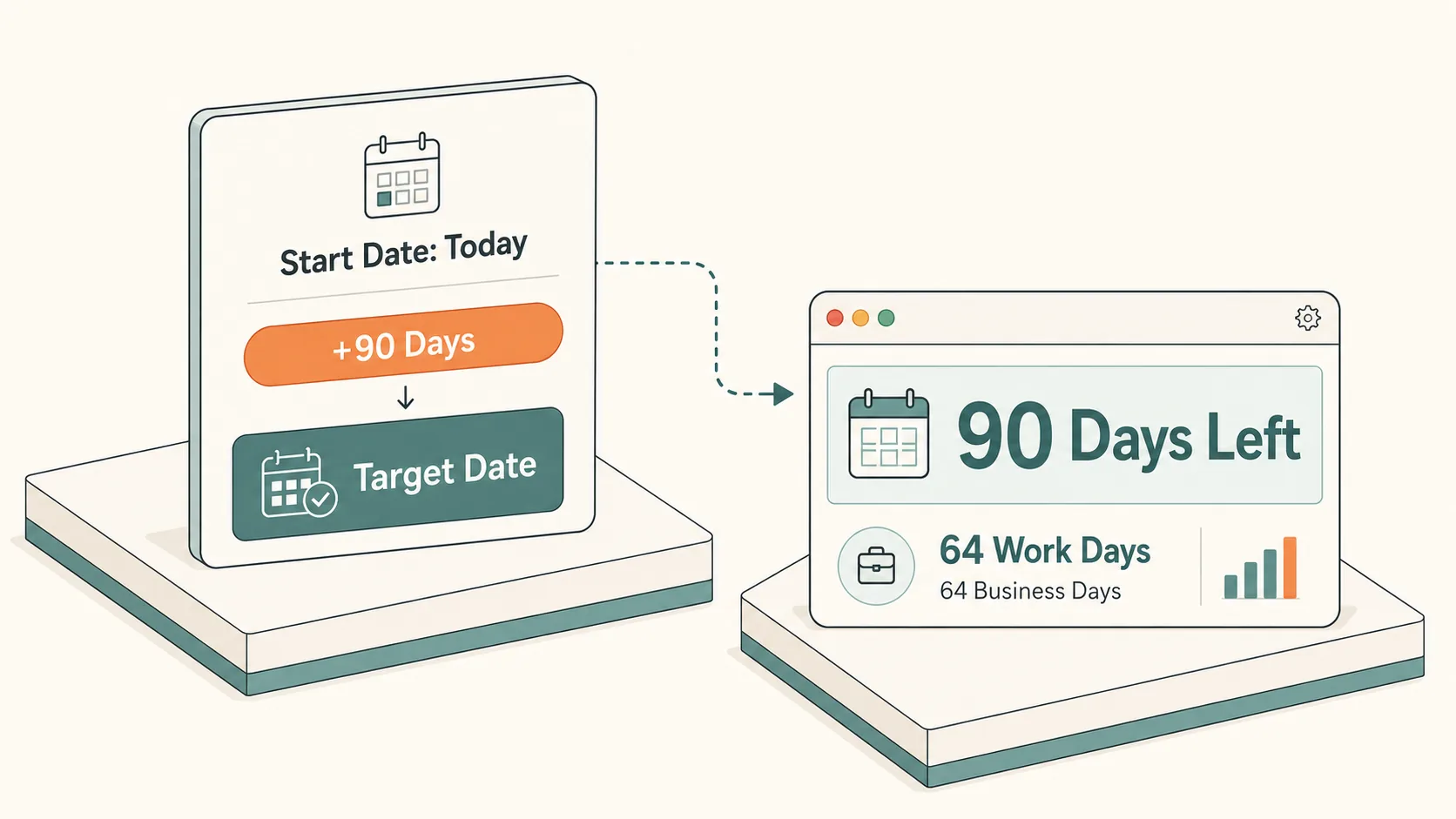
A modern workflow relies on ambient milestone tracking. By pinning a dedicated deadline countdown widget to your Mac desktop, the remaining calendar days and business days automatically update every midnight in sync with your system clock. You maintain effortless awareness of your team’s runway without interrupting your daily focus.
Frequently Asked Questions
Are 90 calendar days exactly three months?
Not exactly. Because calendar months vary between 28, 29, 30, and 31 days, any three consecutive calendar months span between 89 and 92 days. Adding exactly 90 days lands on a slightly different day of the month depending on which seasonal quarter is involved.
How many business days are in 90 days from today?
In 90 calendar days, there are approximately 64 business working days. Every 90-day period contains 12 full weeks (24 weekend days) plus 6 remainder days (adding 1 to 2 weekend days), leaving 64 to 66 active working days before public holidays.
What is the best way to track a 90-day milestone on Mac?
Instead of opening date calculators repeatedly, pin a dedicated deadline countdown widget to your Mac desktop. It updates continuously each midnight, displaying your remaining calendar days and business days at a glance.
Knowing what date is 90 days from today provides clarity for quarterly targets.
Always remember that 90 calendar days equals roughly 64 working days when planning deliverables.
Pin essential milestones to your desktop to keep your team focused and confident through every sprint.
Stay informed with Kepo on your desktop
Embed interactive widgets, monitor dynamic sites, track APIs, and run ambient AI agents right on your macOS desktop.
Related Articles
View all posts →How to calculate days between dates and business days
A comprehensive guide to date interval math: learn how to calculate days between dates and business days, verify inclusive periods, use a handy reference table, and pin live countdown widgets to your desktop.
How to find IP address on Mac: local vs. public IP explained
Learn how to find IP address on Mac across local network interfaces and public gateways. Master Terminal shortcuts, understand private vs. public routing, and pin live network widgets to your desktop.
How to crop an image on Mac: native tools and instant workflows
Learn how to crop image on Mac quickly using Apple Preview, the Photos app, and Finder Quick Actions. Master aspect ratio locking, lossless editing, and desktop widget tools.