IP Address Lookup
Enter an IPv4 or IPv6 address to look up its reported network, autonomous system and approximate location when available. This IP address lookup queries IP Guide, with location data attributed to MaxMind. Missing fields remain unavailable. The result does not identify the person using an address or locate a household.
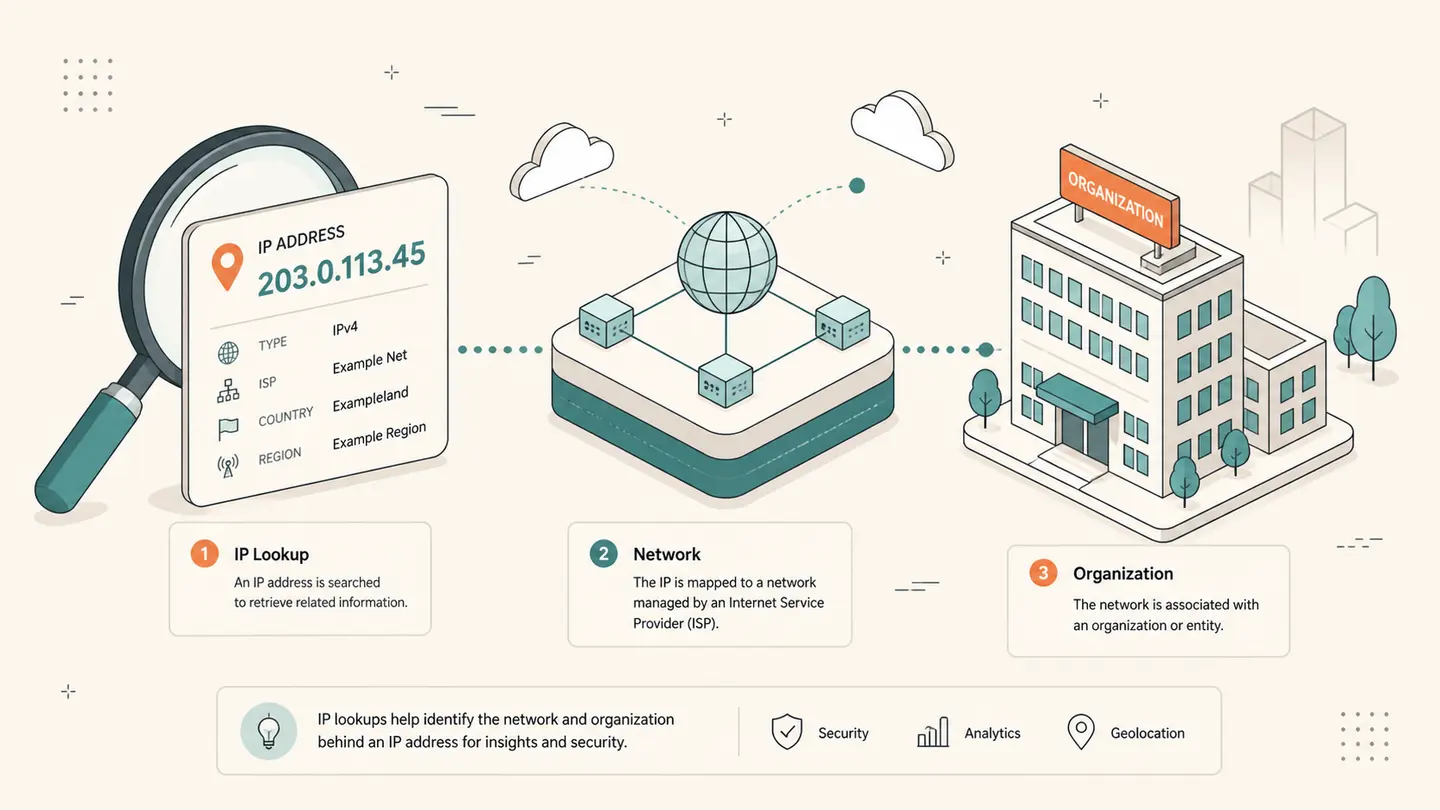
Enter an IPv4 or IPv6 address to look up its reported network, autonomous system and approximate location when available. This IP address lookup queries IP Guide, with location data attributed to MaxMind. Missing fields remain unavailable. The result does not identify the person using an address or locate a household.
Network and approximate location data, with source attribution. Not an exact location or identity search.
Best solution
Enter an IPv4 or IPv6 address to look up its reported network, autonomous system and approximate location when available.
Network and approximate location data, with source attribution. Not an exact location or identity search.
Manual query sends this IP to IP Guide / Neptune Networks. Approximate location data: MaxMind. The provider also sees your request address.

Opens the Kepo download page; this calculation or file is not transferred.
Key solutions at a glance The main decisions from this guide, condensed into one table.
How to Use This Check
Paste one address without a URL scheme, path or port. For example, the public resolver address prefilled in the tool is a demonstration target, not your current address. Choose the public-IP tool instead if your question is which address a website sees when you connect.
Select Look up IP. The request goes directly to IP Guide and does not automatically repeat. The response separates the input address, containing network and autonomous-system information. Check that the displayed IP is the address you intended before interpreting the organization or location fields.
Read the organization as network information. It may describe a cloud provider, ISP or other network operator rather than the company running a particular website. Hosting, customer assignments and shared infrastructure can make those different entities. The result is a clue about the network, not proof of who authored content or controlled an account.
Treat every location field as an estimate and preserve unavailable values. A globally distributed address, VPN exit or recently reassigned range can lack a useful city. Do not substitute your browser location or the provider’s headquarters for a missing value. Copy the full labeled result if you need a record for network troubleshooting.
What the Result Actually Means
An autonomous system is a network represented by an ASN in internet routing. A containing prefix groups addresses into a network range, while a location database estimates where an address is used. These are different data products and can have different update schedules. An IP address lookup can therefore return an ASN with no city, or an organization in one country with an estimated exit in another. Those differences are not automatically errors. This component exposes the supplier’s fields and their limits instead of combining them into a misleading exact map pin.
| Field or observation | Meaning |
|---|---|
| IP | Address returned for the query |
| Prefix | Reported containing network |
| ASN / organization | Network operator information |
| Location | Approximate; may be unavailable |
Limits and Common Misreadings
IP address lookup is not a person search. An address can be shared by many users, change over time or belong to an intermediary. Do not use the result as proof of identity, residence, wrongdoing or a specific person’s activity.
Private addresses are reused in unrelated networks. An internet database cannot tell you which local computer uses the same private address in your home. Check local settings and equipment you administer for that task.
The tool makes a single lookup, not a bulk export or background enrichment job. The external provider receives the queried address and your connection address. Keep sensitive troubleshooting records out of public messages and respect the provider’s usage terms.
An Example of Careful Interpretation: Separate the Observation from Its Cause
Consider a lookup that returns an organization and network prefix but no city. The correct record contains the available network information and an unavailable location field. Filling the city with the organization’s headquarters would combine two different facts and make the result less accurate. Likewise, a cloud-hosted website can use an address registered to its hosting network rather than its own company. Preserve the supplier’s field labels when sharing the observation. If a decision requires reliable location or attribution, this single public database result is not sufficient evidence for that decision.
Keep a Useful Troubleshooting Record
Keep the question, input, observation time and source together. A bare address, percentage or status code is difficult to interpret later because it omits the connection and measurement context. When comparing two observations, note what changed between them: the target, network, VPN state, selected adapter, record type or remote origin. Change one relevant condition at a time when possible. That makes the comparison easier to explain without inventing a cause from one number.
Save only information you actually need. Network records can reveal infrastructure names and connection details, even when they do not contain a password. Remove unrelated identifiers before sharing a screenshot with another person. Never put private credentials in a domain field or publish an internal hostname as part of a public test. A copied result is a snapshot, not a promise that the same conditions still apply when someone reads it later.
Kepo is a Mac desktop-widget product for repeated checks and small workflows. A labeled troubleshooting note or a supported monitoring widget can keep the relevant context accessible while you work. The download link opens the product workflow; this article does not automatically install a configured diagnostic widget, transfer your network inputs or start a scheduled check. Confirm the actual widget’s capabilities before relying on it for ongoing observations.
Choose the next task by the question you need answered.
Frequently Asked Questions
Does ip address lookup describe my entire network?
No. The steps and component above define the scope of this observation. A local adapter value, an external address and a remote probe result describe different viewpoints. Preserve that context and do not generalize a single observation to every application or connection.
What should I do when a result is unavailable?
Keep it marked unavailable. An unfinished or failed observation is not a successful zero result and does not establish the cause of a problem. Check the input and try again later only when another observation is useful. Respect provider limits rather than repeatedly retrying.
Does this page save a monitoring history or install a desktop widget?
No. The page provides the specific manual workflow described above. It does not schedule future tests or create a configured desktop widget. Save the relevant result yourself and use an explicitly supported monitoring feature if you need recurring checks.
Sources and Method
Primary references for the protocol, provider or operating-system steps.
A useful network answer states what was checked, where the observation came from and what remains unknown. Keep those distinctions when you save or share the result.
Stay informed with Kepo on your desktop
Embed interactive widgets, monitor dynamic sites, track APIs, and run ambient AI agents right on your macOS desktop.
Related Articles
View all posts →How to calculate days between dates and business days
Enter two dates to count calendar days, weekdays, and weekends. Check whether to include the end date, follow a worked example, and account separately for holidays.
90 days from today: calculate the exact date
Find the date 90 days from today with the calculator below. See a worked example, compare calendar days with weekdays, and understand why three months can give a different answer.
How to find IP address on Mac: local vs. public IP explained
Learn how to find IP address on Mac across local network interfaces and public gateways. Master Terminal shortcuts, understand private vs. public routing, and pin live network widgets to your desktop.
How to crop an image on Mac: native tools and instant workflows
Crop an image on Mac with Preview or Photos, or try the center-crop tool on this page. Compare selection controls, aspect ratios, PNG export, and ways to preserve the original.