IPv6 Test: Check Both Address Families
Run separate requests to IPv4-only and IPv6-only endpoints and compare the observed outcomes. This IPv6 test can show whether this browser reaches those two services now. It is not a full protocol certification, DNSSEC assessment, router audit or guarantee of connectivity to every IPv6 destination.
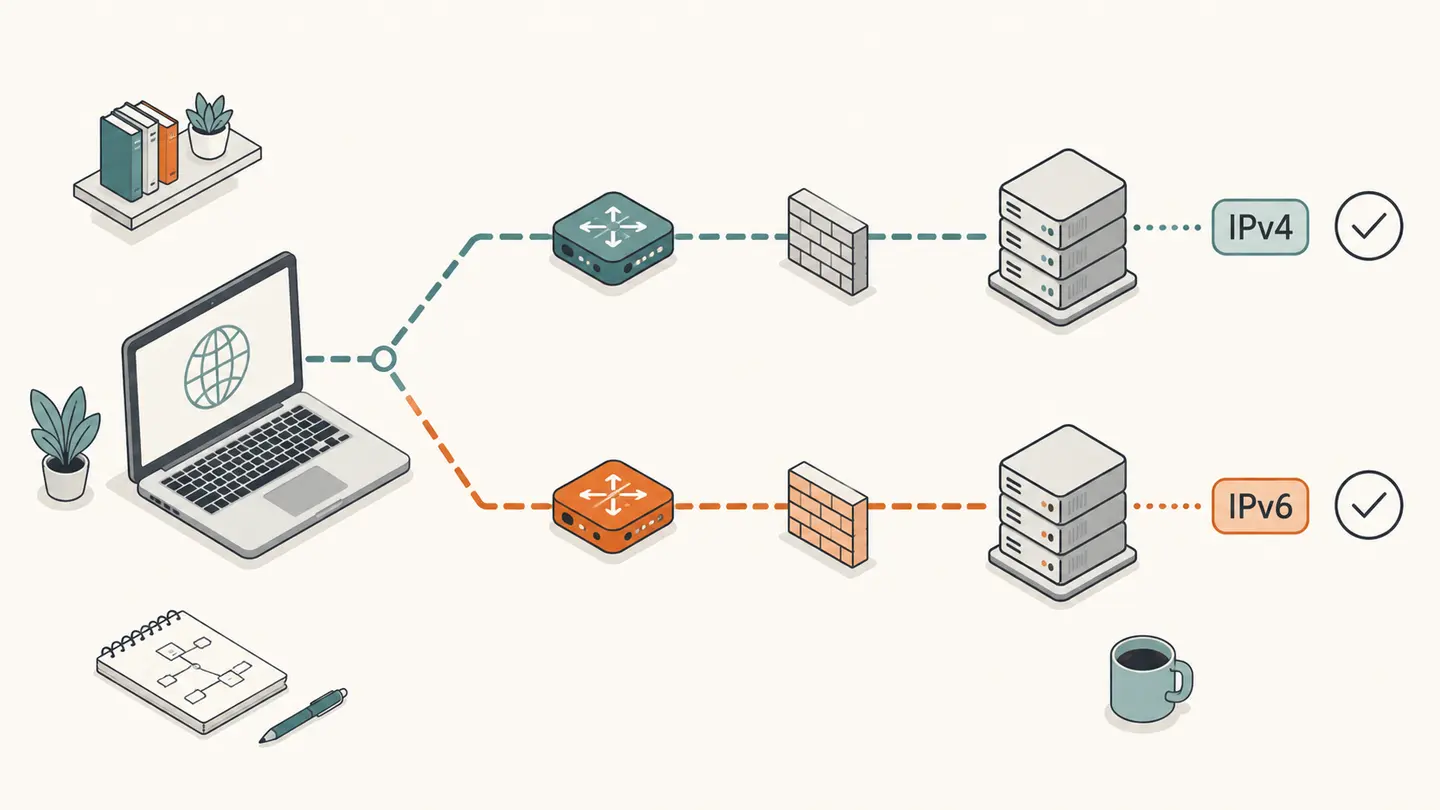
Run separate requests to IPv4-only and IPv6-only endpoints and compare the observed outcomes. This IPv6 test can show whether this browser reaches those two services now. It is not a full protocol certification, DNSSEC assessment, router audit or guarantee of connectivity to every IPv6 destination.
Independent endpoint results. A failure remains unavailable, not a fabricated protocol diagnosis.
Best solution
Run separate requests to IPv4-only and IPv6-only endpoints and compare the observed outcomes.
Independent endpoint results. A failure remains unavailable, not a fabricated protocol diagnosis.
Start a lookup to see the address visible to ipify.
A VPN, proxy or relay can change the observed address. HTTPS request time is not ICMP ping, packet loss or internet speed.
Clicking Check contacts ipify, which sees the request address. Results stay in this page. No automatic polling.

Opens the Kepo download page; this calculation or file is not transferred.
Key solutions at a glance The main decisions from this guide, condensed into one table.
How to Use This Check
Keep the browser, network and VPN state stable for the comparison. The two endpoint requests are intended to describe the same connection context. If you change routes during the test, record that change and avoid interpreting the pair as a clean comparison.
Select Check connection to start the independent IPv4 and IPv6 requests. Each endpoint has its own timeout and validated address result. The IPv6 test does not call a dual-stack service and infer both families from whichever route happened to win one request.
Read each outcome separately. IPv4 success and IPv6 failure mean that the first endpoint was reached while the second was not reached successfully in this observation. That is narrower than identifying a broken router, unsupported operating system or unavailable ISP protocol.
If you compare before and after a network change, preserve both observations and timestamps. A temporary provider outage or browser extension rule can affect one endpoint. Repeating the same controlled check can be useful; repeatedly changing several settings at once makes the evidence less clear.
What the Result Actually Means
A dual-stack connection can use IPv4 and IPv6, but a single normal website request often exposes only the path actually used. This IPv6 test explicitly queries family-specific endpoints so one result cannot stand in for the other. The component displays the addresses and HTTP timings returned by those observations. Those timings are not equivalent to an ICMP comparison or a broad benchmark of the two protocols. The endpoints, browser behavior and route all influence the measured request duration.
| Field or observation | Meaning |
|---|---|
| Both succeed | Both selected endpoints were reachable |
| IPv4 only succeeds | IPv6 endpoint observation failed; cause undetermined |
| IPv6 only succeeds | IPv4 endpoint observation failed; cause undetermined |
| Both fail | Check unavailable; not proof of total disconnection |
Limits and Common Misreadings
This IPv6 test is deliberately scoped to endpoint reachability. It does not examine every DNS configuration, maximum transmission unit, fallback behavior or application protocol on your network.
Do not compare two HTTP timings as a universal statement that one address family is faster. A useful performance comparison needs matched targets, repeated samples and a defined measurement method.
The two providers’ endpoint requests disclose your source addresses to the service. There is no automatic refresh loop or hidden history. Copy results only when the connection information is necessary for your troubleshooting task.
An Example of Careful Interpretation: Separate the Observation from Its Cause
Consider a laptop whose IPv4 check succeeds and whose IPv6-only request times out. The test establishes two endpoint outcomes, not the location of a fault. You can compare a second authorized connection, such as a different network you normally use, while leaving the browser unchanged. If the outcome changes, that narrows the comparison but still does not identify a particular router setting automatically. Keep both result pairs and their timestamps. A useful IPv6 test report states the services reached, the services not reached and the controlled change between observations.
Keep a Useful Troubleshooting Record
Keep the question, input, observation time and source together. A bare address, percentage or status code is difficult to interpret later because it omits the connection and measurement context. When comparing two observations, note what changed between them: the target, network, VPN state, selected adapter, record type or remote origin. Change one relevant condition at a time when possible. That makes the comparison easier to explain without inventing a cause from one number.
Save only information you actually need. Network records can reveal infrastructure names and connection details, even when they do not contain a password. Remove unrelated identifiers before sharing a screenshot with another person. Never put private credentials in a domain field or publish an internal hostname as part of a public test. A copied result is a snapshot, not a promise that the same conditions still apply when someone reads it later.
Kepo is a Mac desktop-widget product for repeated checks and small workflows. A labeled troubleshooting note or a supported monitoring widget can keep the relevant context accessible while you work. The download link opens the product workflow; this article does not automatically install a configured diagnostic widget, transfer your network inputs or start a scheduled check. Confirm the actual widget’s capabilities before relying on it for ongoing observations.
Choose the next task by the question you need answered.
Frequently Asked Questions
Does ipv6 test: check both address families describe my entire network?
No. The steps and component above define the scope of this observation. A local adapter value, an external address and a remote probe result describe different viewpoints. Preserve that context and do not generalize a single observation to every application or connection.
What should I do when a result is unavailable?
Keep it marked unavailable. An unfinished or failed observation is not a successful zero result and does not establish the cause of a problem. Check the input and try again later only when another observation is useful. Respect provider limits rather than repeatedly retrying.
Does this page save a monitoring history or install a desktop widget?
No. The page provides the specific manual workflow described above. It does not schedule future tests or create a configured desktop widget. Save the relevant result yourself and use an explicitly supported monitoring feature if you need recurring checks.
Sources and Method
Primary references for the protocol, provider or operating-system steps.
A useful network answer states what was checked, where the observation came from and what remains unknown. Keep those distinctions when you save or share the result.
Stay informed with Kepo on your desktop
Embed interactive widgets, monitor dynamic sites, track APIs, and run ambient AI agents right on your macOS desktop.
Related Articles
View all posts →How to find IP address on Mac: local vs. public IP explained
Learn how to find IP address on Mac across local network interfaces and public gateways. Master Terminal shortcuts, understand private vs. public routing, and pin live network widgets to your desktop.
What Is My IP Address?
Your public IP address is the address an internet service sees for the connection reaching it. Select Check connection to query the IPv4 endpoint below. A VPN, proxy or shared network can change the address that service sees. This is different from the private address shown in your computer’s network settings.
What Is My IPv6 Address?
Use a request to an IPv6-only address service to see the IPv6 address that service observes for your connection. Select Check connection below. If the request fails, the address is unavailable for this test; that alone cannot identify whether the cause is your ISP, routing, a browser extension or the service.
How to calculate days between dates and business days
Enter two dates to count calendar days, weekdays, and weekends. Check whether to include the end date, follow a worked example, and account separately for holidays.