Weeks Between Dates
Find the calendar-day difference between two dates, then divide by seven. The calculator displays complete weeks plus remaining days. By default the end date is excluded; including it adds one counted date before the week calculation.
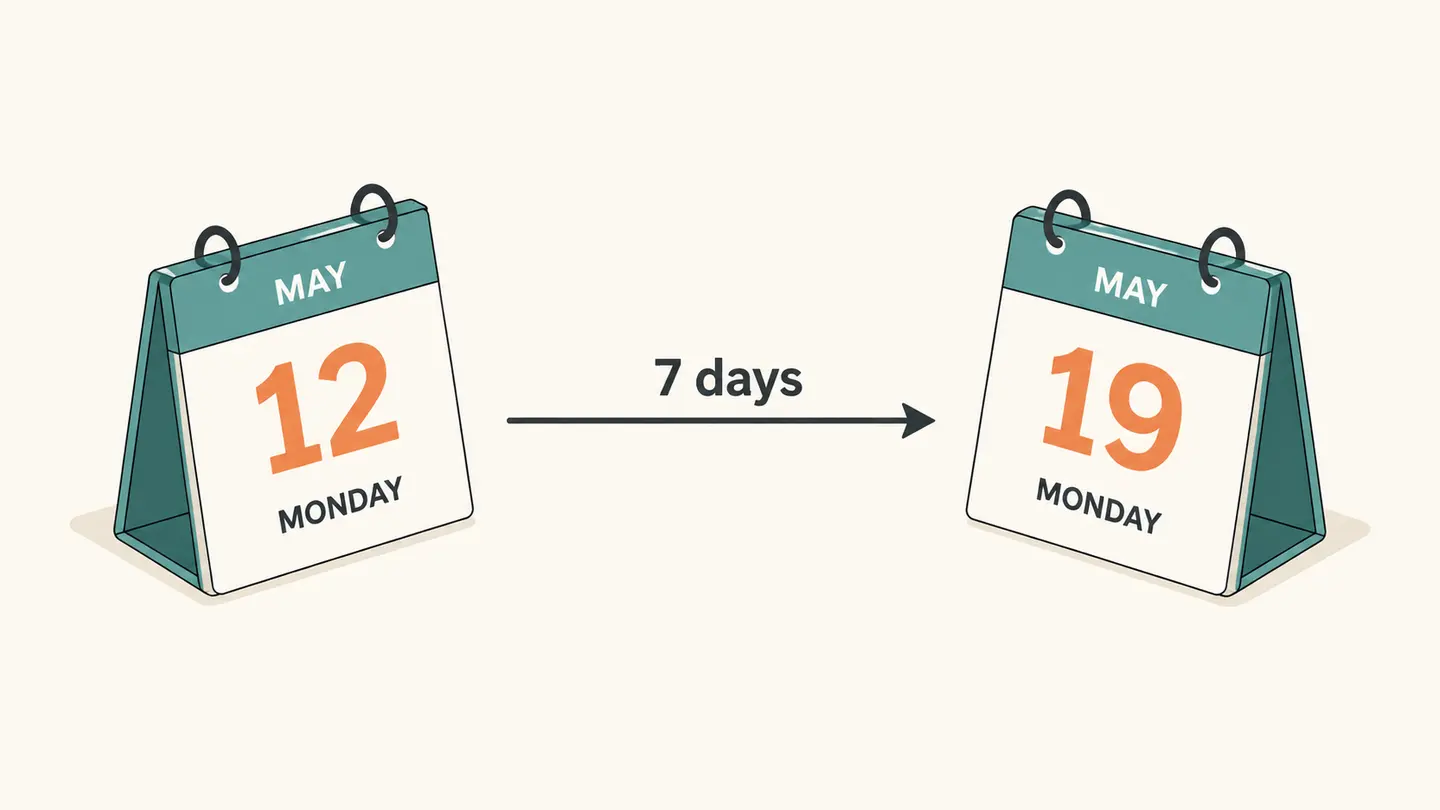
Find the calendar-day difference between two dates, then divide by seven. The calculator displays complete weeks plus remaining days. By default the end date is excluded; including it adds one counted date before the week calculation.
Calendar dates divided into seven-day groups, with an explicit end-date option.
Best solution
Find the calendar-day difference between two dates, then divide by seven.
Calendar dates divided into seven-day groups, with an explicit end-date option.
Complete weeks + days
12w 6d
90 elapsed days · 65 Mon–Fri dates
Civil dates, not elapsed hours. No holidays deducted.

Opens the Kepo download page; this calculation or file is not transferred.
Key solutions at a glance The main decisions from this guide, condensed into one table.
Use the Calculator
Enter the start and end in chronological order. Use complete dates including their years, especially when an interval crosses New Year. The tool rejects a reversed range rather than quietly swapping dates and hiding an input mistake.
Decide whether the end date belongs in the counted period. September 1 to September 8 has a seven-day difference. Counting both September 1 and September 8 as included dates gives eight dates instead. Choose the rule that describes the question you are answering.
Read the complete-week result and its day remainder. A ten-day difference contains one full week and three days. It is not two complete weeks merely because the interval touches parts of two rows in a calendar app. Calendar-row counts depend on where the week begins.
For a decimal representation, divide the displayed counted days by seven. The complete-week display intentionally keeps the remainder visible, because a value such as 1.4286 weeks can hide the practical fact that there are three dates beyond the first complete week.
How the Calculation Works
Every full seven-date block contributes one complete week. The number of complete weeks is the whole-number quotient of counted days divided by seven; the remaining days are the remainder of that division. This rule does not depend on whether your calendar grid begins on Sunday or Monday. It also differs from ISO week numbers, which label weeks in a year rather than measuring the length of a chosen interval.
A Practical Walkthrough: Compare the Inputs and Counting Rules Before Saving the Result
A plan running from Wednesday, September 2, 2026 to Monday, September 14 spans twelve elapsed calendar dates under the default end-excluded rule. Divide twelve by seven: one complete week accounts for seven days and five days remain. The result is one week and five days, even though the dates may occupy parts of three calendar rows in a month view. Now include the end date. The counted total becomes thirteen, so the result becomes one week and six days. That change is a counting decision, not evidence that the calendar has gained an extra elapsed twenty-four-hour period. If you extend the end to September 16 with the end excluded, the interval is fourteen days, or two complete weeks. These comparisons are useful because each changes one input while preserving the start and unit. They also show why rounding up would answer a different question: a twelve-day interval touches a second seven-day block but has not completed two weeks. For a weekly review plan, save the exact start and end dates rather than only the rounded number of weeks. A colleague using a Sunday-first calendar and you using a Monday-first calendar should still obtain the same duration when both endpoints and the counting rule match.
Worked Reference Examples
| Input | Counting rule | Result |
|---|---|---|
| 2026-09-01 → 2026-09-08 | End excluded: 7 days | 1 week, 0 days |
| Same dates | End included: 8 days | 1 week, 1 day |
| 2026-09-01 → 2026-09-11 | End excluded: 10 days | 1 week, 3 days |
| 2026-12-20 → 2027-01-03 | End excluded: 14 days | 2 weeks, 0 days |
Use these examples to verify the mode before entering your own values. Change one setting at a time so you can identify why the result changes. The examples are fixed demonstrations; they are not automatically updated personal data or recommended dates for your own task.
Important Boundaries
Weeks between dates does not mean working weeks. The counted interval includes Saturdays, Sundays and holidays. Five workdays can be spread across more than seven calendar dates if closures intervene, so a working-day question needs its own inputs.
A schedule that starts on Wednesday and ends the next Tuesday can touch two displayed calendar rows while still spanning less than seven elapsed dates. Count the actual interval rather than the number of visible rows or named week labels.
For an ongoing weekly plan, save both endpoints or the resulting target date. A reusable desktop note can retain this context; repeatedly recalculating from a moving “today” changes the original interval.
Save a Result You Can Recheck
Keep the original inputs with the result. A bare number such as five, thirty or one hundred does not tell a later reader whether it represents dates, weekdays, minutes or complete anniversaries. The copy action records the selected calculation context, and it confirms success only after the browser accepts the clipboard operation.
Calculation fields stay on this device. Closing or refreshing the page is not a promise of persistent storage, and no account is needed to use the tool. If an input is incomplete or invalid, the component hides the previous numerical result and explains what needs changing. Do not use an old screenshot as a result for new inputs.
Kepo offers Mac desktop widgets for repeated checks and small personal workflows. You can explore those capabilities through the download page, but this calculator does not automatically transfer its inputs, save a reminder or generate a configured widget. Preserve the result yourself before moving to a desktop workflow.
Frequently Asked Questions
Does a week always contain seven days here?
Yes. The result groups counted calendar dates into blocks of seven.
Are these ISO week numbers?
No. They are a duration in weeks and days, not week-of-year labels.
Why does including the end change the answer?
It adds one counted date before dividing the total into complete weeks and a remainder.
A useful result includes the inputs, unit and counting convention. Keep all three when you save or share it.
Stay informed with Kepo on your desktop
Embed interactive widgets, monitor dynamic sites, track APIs, and run ambient AI agents right on your macOS desktop.
Related Articles
View all posts →How to calculate days between dates and business days
Enter two dates to count calendar days, weekdays, and weekends. Check whether to include the end date, follow a worked example, and account separately for holidays.
Business Days Calculator
Count working dates between two calendar dates, using the non-working weekdays and excluded dates you specify. The default week is Monday through Friday. The start is included and the end is excluded unless you select Include end date; holidays are deducted only when you enter them.
Age Calculator: Years, Months and Days
Choose a date of birth and a reference date to calculate completed calendar years, months and remaining days. The component also shows the next birthday under its stated month-end convention. It is a calendar calculation for personal use, not a legal age or eligibility determination.
Months Between Dates
Count completed calendar-month anniversaries from the starting date, then count the remaining days. When an anniversary day does not exist in the target month, this calculator uses that month’s last date. It does not divide every interval by thirty.